This list of birds of Great Britain comprises all bird species which have been recorded in a wild state in Great Britain. In general the avifauna of Britain is similar to that of Europe, although with fewer breeding species. There are 598 species of birds on the British list as of 7 February 2015, with the latest additions being the alder flycatcher (Empidonax alnorum) and Moltoni's warbler The species order and scientific names used here follow that of the official British list, maintained by the British Ornithologists' Union (BOU).Decisions relating to the British list are published by the British Ornithologists' Union Records Committee (BOURC) in its annual reports in the Ibis, the journal of the BOU. These reports were formerly geographically based and included the whole of the British Isles, but records for the Republic of Ireland and Northern Ireland are now published by their own ornithological associations. Records from the Isle of Man, although adjudicated by the Manx Ornithological Society, continue to be published in the BOU reports.
The BOU uses the following categories for British bird species:
- A: species which have been recorded in an apparently natural state at least once since 1 January 1950.
- B: species which were recorded in an apparently natural state at least once between 1 January 1800 and 31 December 1949, but have not been recorded subsequently.
- C: species that, although originally introduced by man, either deliberately or accidentally, have established breeding populations derived from introduced stock, that maintain themselves without necessary recourse to further introduction.
Categories A, B and C constitute the Official British List. Birds can be listed in more than one category, for example the Canada goose has a large introduced population, but there have also been a few naturally occurring vagrants, so it meets the criteria for categories A and C. Two further categories are used for record keeping only.
- D: species that would otherwise appear in Categories A or B except that there is reasonable doubt that they have ever occurred in a natural state.
- E: species that have been recorded as introductions, transportees or escapees from captivity, and whose breeding populations (if any) are thought not to be self-sustaining.
Birds in Categories D and E are not on the official British list and are not included here. A sixth category, Category F, is being compiled to include species recorded before 1800 including fossil species.
Species listed as rare here are those for which a full description is required for acceptance of the record by the British Birds Rarities Committee. Other species have an indication of their breeding and wintering status in Great Britain.
Because of its mild winters, Great Britain has a considerable population of wintering species, particularly ducks, geese and swans. There are also a number of species, such as the oystercatcher, that are resident in this island, but migrants elsewhere. Also because of its position, Britain receives a number of vagrants from Asia and North America. Some American gulls, ducks and waders are regular enough not to be considered rare. These include the ring-billed gull, surf scoter and pectoral sandpiper.
Golden Pheasant
The golden pheasant or Chinese pheasant, (Chrysolophus pictus) is a gamebird of the order Galliformes (gallinaceous birds) and the family Phasianidae (pheasants). It is native to forests in mountainous areas of western China, but feral populations have been established in the United Kingdom, Canada, United States, Mexico, Colombia, Peru, Bolivia, Chile, Argentina, Uruguay, Falkland Islands, Germany, Belgium, Netherlands, France, Ireland,Australia and New Zealand. In England they may be found in East Anglia in the dense forest landscape of the Breckland.
The adult male is 90–105 cm in length, its tail accounting for two-thirds of the total length. It is unmistakable with its golden crest and rump and bright red body. The deep orange "cape" can be spread in display, appearing as an alternating black and orange fan that covers all of the face except its bright yellow eye with a pinpoint black pupil.
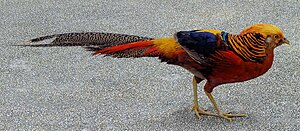
Males have a golden-yellow crest with a hint of red at the tip. The face, throat, chin, and the sides of neck are rusty tan. The wattles and orbital skin are both yellow in colour, and the ruff or cape is light orange. The upper back is green and the rest of the back and rump is golden-yellow. The tertiaries are blue whereas the scapulars are dark red. Other characteristics of the male plumage are the central tail feathers, black spotted with cinnamon, as well as the tip of the tail being a cinnamon buff. The upper tail coverts are the same colour as the central tail feathers. The male also has a scarlet breast, and scarlet and light chestnut flanks and underparts. Lower legs and feet are a dull yellow.
The female (hen) is much less showy, with a duller mottled brown plumage similar to that of the female common pheasant. She is darker and more slender than the hen of that species, with a proportionately longer tail (half her 60–80 cm length). The female's breast and sides are barred buff and blackish brown, and the abdomen is plain buff. She has a buff face and throat. Some abnormal females may later in their lifetime get some male plumage. Lower legs and feet are a dull yellow.
Both males and females have yellow legs and yellow bills.
Redhead
The redhead is a pochard, a diving duck specially adapted to foraging underwater. Their legs are placed farther back on the body, which makes walking on land difficult, the webbing on their feet is larger than dabbling ducks and their bills are broader, to facilitate underwater foraging. In addition, pochards have a lobed hind toe. No pochard has a metallic coloured speculum, something that is characteristic of other ducks.

Males
During breeding season, adult males have a copper head and neck, with a black breast. The back and sides are grey, the belly is white and the rump and tail are a light black. Male bills are pale blue with a black tip and a thin ring separating the two colours. Non breeding males lose the copper colour and instead have brown heads.
Females
Adult females, however, have a yellow to brown head and neck. The breast is brown, the belly is white and the rest of the body is a grey to brown. The female bills are slate with a dark tip that is separated by a blue ring. Females remain the same colour year round.
Red-billed tropicbird
The red-billed tropicbird (Phaethon aethereus), also known as the boatswain bird is a tropicbird, one of three closely related seabirds of tropical oceans.

The adult is a slender, mainly white bird, 48 cm long, excluding the central tail feathers which double the total length, and a one-metre wingspan. The long wings have black markings on the flight feathers. There is black through the eye. The bill is red. Sexes are similar, although males average longer tails. Juveniles lack the tail streamers, are greyer-backed, and have a yellow bill. P. a. indicus has a reduced black eye stripe, and a more orange-tinted bill.Its wind are made up of very large feather coat. They feed on fish and squid, but are poor swimmers.


.jpg)